
Attendance
Regular school attendance is essential to give your child the best opportunities in life.
Good attendance means a child is less likely to fall behind with their work and more likely to do well in exams. Much of the work children miss when they are absent is never made up and this can leave children at a disadvantage for the remainder of their school career. Attending school is therefore vital if your child is to achieve their full potential.
Research suggests that students who attend school regularly could be less likely to be involved in antisocial behaviour or crime.
We believe good attendance is everyone's responsibility and therefore we aim to work with parents, pupils and staff across the school to ensure all pupils achieve the maximum possible attendance.
Attendance Policy
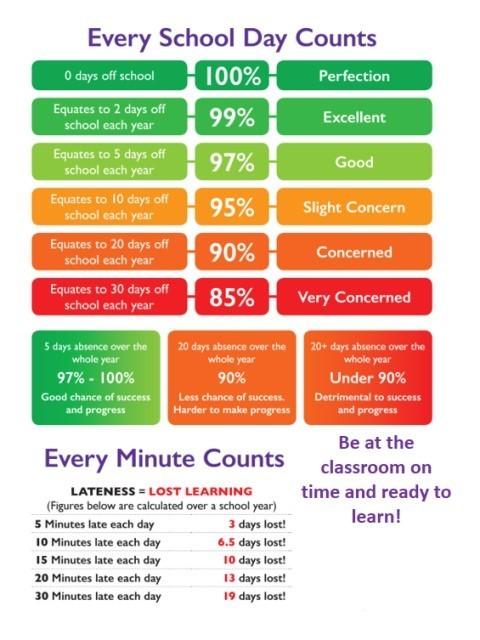
Every Minute Matters
If you child arrives late to school everyday, their learning begins to suffer.
5 minutes late every day adds up to missing 3 school days
10 mins late every day adds up to missing 6.5 days of school a year.
15 ins late a day means your child is missing 10 days of school a year.
being late by 20 mins each day means your child misses 13 days of school a year.
missing 30 mins of school every day means your child misses 19 school days a year.
How can Parents and Carers help to ensure good attendance at school: -
- Send your child to school every day
- Ensure child is arrives punctually
- Ensure child know how important education is
- Encourage your child and show an interest
- Attend school open evenings and school events
- Avoid taking family holidays during term time
- Make sure your child gets a good night rest
Absences can hide problems that we could be sorting out together.
If your child is not wanting to attend school for any reason (feeling unwell etc) often is a sign that there is something worrying your child.
Even small issues can be massive worries or concerns to a child. If your child behaviour changes or they are pretending to be sick or just wanting to make excuses to stay at home please consider if there is something worrying your child and speak to the school.
What should you do if your child refuses to attend school?
- Make contact with the school – we may be able to help
- Do not cover for your child
- Help the school to help put things right
- Make sure that the child understands that you do not approve of them being absent
It is the parent’s and Carers responsibility to let the school know the reason for their child’s absence as soon as possible, on the first and every day of the absence.
Parents and Carers can only explain absences; they cannot authorise them.
A guide to keeping kids healthy this school year for parents and carers – UK Health Security Agency